
The NAG building
Your
Berlin WelcomeCard
takes you here with ease.

The building is currently closed. The Schönweide Industrial Museum will post an update on its website when the building reopens for guided tours.
Over the next few years, a new neighbourhood is to be developed across the entire site in Oberschöneweide, combining commercial, residential, educational and cultural facilities. At the same time, listed buildings are to be preserved and space created for new developments. New public squares and a continuous riverside promenade are also planned. The site will remain accessible throughout the entire transformation process. Experience first-hand how a former industrial site is being transformed into an innovative location with people at the centre.
Historic start-up centre
At the end of the 19th century, Oberschöneweide became a centre for industrial enterprises, particularly from the electrical sector. One of them, AEG, later became a global corporation. Its founder, the industrialist Emil Rathenau, was already convinced of the future importance of the automobile at the turn of the century and founded Neue Automobil-Gesellschaft AG in 1901.
When the First World War broke out, the company stopped manufacturing civilian commercial vehicles and started producing goods for the war effort such as troop transporters and aeroplanes. The production facility was patriotically renamed the Nationale Automobil-Gesellschaft in 1915.
A new building by Behrens
During the war, production continued to increase, so Emil Rathenau decided to build a new factory. The contract went to the architect Peter Behrens, who had been a member of the artistic advisory board of AEG since 1907 and built the AEG turbine hall in Moabit in 1909.
With the turbine hall, Behrens had already succeeded in laying the foundation for modern industrial architecture. Suddenly, types of building which had previously been designed on a purely functional basis became the focus of architecture. Before the turn of the century, civil engineers designed simple production halls, often giving them a pseudo-historical façade that disguised their working function.
Walter Gropius, who as a young architect worked for Behrens, said in 1911:
“As workplaces we must erect palaces which not only give the factory worker, that slave of modern industrial production, light, air and cleanliness, but also convey to them something of the nobility of the great communal idea that drives the whole undertaking.”
Peter Behrens knew how to build palaces for work, and proved it in Oberschöneweide too. Between 1915 and 1917, in the middle of the war, a building was erected that combined industrial production and modern architecture. Emil Rathenau didn’t live to see its completion, having died in 1915. The business was taken over by his son Walther Rathenau, who later became Germany’s Foreign Minister.
External appearance
For the NAG building, now also known as the Peter Behrens Building, the architect combined individual parts of the facility, such as halls and multi-storey factories, in a single monumental building with a 1,000-meter-long façade.
The administration and production were housed in a five-storey building arranged around the assembly hall like a horseshoe. In the middle was a 60-metre-high tower which supplied the plant with fresh water. The water tower is still one of the most striking architectural monuments in Oberschöneweide and gives the Peter Behrens Building an appearance reminiscent of a town hall. He integrated the industrial building into the cityscape and linked automotive production to public life in Oberschöneweide.
As with the AEG turbine hall in Moabit, Behrens used classic architectural elements for the façade design: the broad pillars between the windows looked like pilasters, flattened half-columns raised from the wall. The fifth floor was designed as a mezzanine, a stylistic device that dates back to the Renaissance. The clear forms and the structure provided by the water tower opened up the façade.
Redesigned lighting
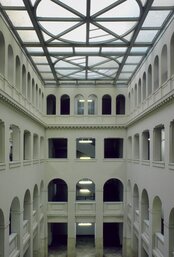
Visitors enter a bright entrance hall through a large, arched gateway. Its mundane function as a stairwell gives way to a sense of solemn grandeur. Anyone who ascends the steps of the entrance hall today immediately senses the company’s scale and significance thanks to the impressive lighting atmosphere.
Even today, one cannot help but sense the ‘special spirit’ of this atrium, which soars over four storeys and is illuminated by a high skylight. This sublime sense of space illustrates the architect’s vision: Peter Behrens combines the industrial production processes of factory manufacturing with the formal language of classical culture. The arcades and arches are reminiscent of an Italian Renaissance theatre, though their forms are simplified and thus become more monumental.
NAG’s car production ceased in 1934. Telefunken moved in and developed the first television technology here for the broadcast of the 1936 Olympic Games. After the Second World War, the Oberspreewerk was developed under Russian management; it was the forerunner of the later television electronics plant, which, with around 9,000 employees, was East Berlin’s largest factory until 1989.
Following reunification, Samsung took over the building and, until 2005, produced colour picture tubes for the European market in a new wing of the building. Since 2010, it has been owned by a property company that lets space to small and medium-sized enterprises. Since 2019, DIE AG (Deutsche Immobilien Entwicklungs AG) has been developing the site into the ‘Behrens-Ufer’ complex. The Peter Behrens building has gained new fame as a result of filming for the series Babylon-Berlin. The building serves as the backdrop for a wide variety of locations, from the rooftop shootout to Dr Schmidt’s sanatorium.
Guided tours
The Industriesalon Schöneweide offers expert-led tours of the building. These also include a climb up the Behrens Tower with its panoramic terrace and a fantastic view over almost the whole of Berlin. However, the building is currently closed, and no guided tours can take place. You can find more information on the Industriesalon’s website below.
Our tips for exploring the Behrens building
Near the Peter Behrens Building, you’ll find another AEG industrial monument: the Oberspree Cable Worksat Wilhelminenhofstraße 75 ,built between 1897 and 1914 . It is closely linked to the significant history of Berlin’s electrical industry. Today, the University of Applied Sciences uses the buildings. When you enter the grounds, you’ll find a large historical display in the central courtyard that tells the story of the site’s past.
The nearby Volkspark Wuhlheide is well worth a visit. The ‘Waldpark’, laid out in 1920, is ideal for long walks. The FEZ leisure and recreation centre is also located here. Opened in 1979 as the ‘Pionierpalast Ernst Thälmann’, it is now Europe’s largest centre for children, young people and families, offering a wide range of sports and play facilities.
How to get there
You can reach the Behrensbau by taking tram lines 27, 60, 61 or 67 (Rathenaustraße/HTW stop). To explore the city, we recommend using the Berlin Welcome Card for public transport.

