

Samurai Museum Berlin
Europe’s only museum for Japanese samurai culture
Over 1,000 original exhibits spanning 1,000 years of samurai history - Europe’s only museum of its kind, in Berlin-Mitte.
The Samurai Museum Berlin is Europe’s only museum dedicated exclusively to the culture, history and way of life of the samurai – a place where the past meets the future.
The collection comprises more than 4,000 original historical objects and ranks among the most significant private collections of its kind worldwide. Among the exhibits are, amongst other things, magnificent samurai armour, the legendary katana, intricately crafted masks, works of art and other original artefacts from Japanese history. The Peter Janssen Collection is one of the largest private collections in the world.
The Samurai Myth in Berlin: the new museum
Even the entrance is something to behold: the new Samurai Museum Berlin welcomes visitors with an ornate gateway, specially imported from Japan, from an old samurai residence. Once you’ve stepped through it, you embark on an extraordinary journey through time, exploring the more than 1,000-year history and culture of the legendary Japanese warrior caste.
Around 1,000 historical exhibits are on display in the permanent exhibition. The focus is on the craftsmanship of these Japanese legends: artfully crafted armour, swords and masks tell the story of samurai culture from its beginnings in the late Kofun period around 500 AD right through to the early Meiji period in the 19th century.

Masterpieces of Japanese craftsmanship
It is not only the art of armoury, but artefacts from all aspects of samurai life that trace the development of this influential society, which continues to exert a formative influence on modern Japanese culture. The exhibition at the Samurai Museum Berlin therefore covers far more than just warfare: the role of women in samurai society is explored, as are religion, the mysterious ninja and rituals such as the Japanese tea ceremony, Noh theatre and taiko drumming.
Other highlights include exquisite masterpieces of Japanese craftsmanship such as tea ceramics, textiles, Buddhist sculptures, paintings and woodblock prints.

Through a series of changing special exhibitions, the museum traces a path from the era of the feudal warrior elite to present-day Japan: here, contemporary Japanese art and modern forms of expression such as manga, anime and gaming culture all find their place.
Interactive multimedia journey through time
The tour begins with an interactive 3D model of Japan, which introduces visitors to the country’s history within its global context. Weapons, armour and masks can be experienced up close in 360-degree displays, whilst dynamic projections bring legendary scenes from the samurai wars to life.
Multimedia installations provide an insight into the production processes behind these extraordinary crafts and demonstrate, step by step, how a samurai sword is forged.
Image gallery


Samurai Museum Berlin, Besucher:innen
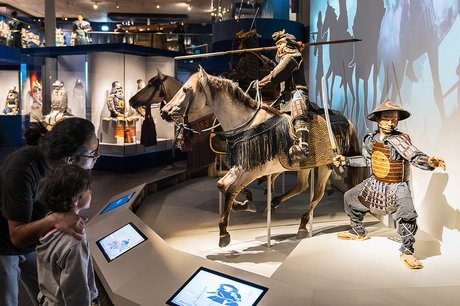
Samurai Museum Berlin, Ausstellungssaal

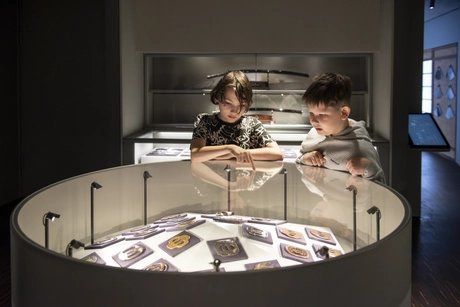









From a flea market find to one of the world’s largest private collections
It all began almost 40 years ago on Straße des 17. Juni in Berlin: the young entrepreneur Peter Janssen, an enthusiastic martial artist with a great passion for Japanese culture, discovered anold katana – the blade of a Japanese long sword – amongst the usual bric-a-brac. This find became the inspiration and the cornerstone of a steadily growing private collection of Japanese samurai art.

Over many decades, Peter Janssen has continuously expanded the collection with growing expertise. Today, it comprises more than 4,000 artefacts from the most diverse aspects of samurai life.
In 2017, he opened his first museum at Villa Clay in south-west Berlin, where he exhibited selected pieces. A few years later, in Berlin’s new cultural centre at Auguststraße 68, he found the ideal venue for his growing collection – spacious and offering the necessary facilities for an interactive, high-tech exhibition in dialogue with the original historical artefacts.
Since May 2022, the Samurai Museum Berlin, in the heart of the city, has been inviting visitors on a fascinating journey into the extraordinary past of the samurai.
These are the exhibits you shouldn’t miss at the Samurai Museum Berlin
- Gomai-Dō armour with white lacing (Edo period, 17th–18th centuries)
- Colour woodblock print‘The Great Battle between the Fish and Vegetable Armies’ (1859)
- Full-face mask of a crow tengu (Muromachi & Edo periods, 16th–18th centuries)
- Star-shaped helmet shell ( early Kamakura period, 1185–1333)
- The blade of Rai Kunimitsu (late Kamakura period, 14th century)
- Freshwater vessel for the tea ceremony (Momoyama period, 16th century)
- Original armour from the Date Masamune clan. The‘One-Eyed Dragon of Ōshū (1567–1636)’ is a pop-culture icon and the inspiration for Darth Vader.

Your visit
The Samurai Museum Berlin is almost entirely accessible: 98 per cent of the exhibition can be viewed in a wheelchair or with a walking aid (the only exception being one installation). There is a lift in the building to take you to the first floor.
You can easily reach the Samurai Museum by taking the U6 underground to Oranienburger Tor or the U8 to Rosenthaler Platz. Alternatively, take the S1 , S2, S25 or S26 S-Bahn to Oranienburger Straße.
More cultural attractions nearby
You are in the heart of Berlin, right in the middle of one of the capital’s most renowned gallery districts.
During the annual Gallery Weekend, not only do the many art galleries open their doors here, but numerous events also take place.
From Auguststraße, it’s just a stone’s throw to the major sights of Berlin’s historic centre: just round the corner, on Oranienburger Straße, lies the New Synagogue. Crossing the picturesque Monbijou Bridge takes you to the tip of the world-famous Museum Island, a UNESCO World Heritage Site. The Museum Island is also home to Berlin Cathedral, opposite the Humboldt Forum, where you can gain further in-depth insights into Asian culture at the Museum of Asian Art. From there, you can use the ‘Museum Line’ – the U5 underground line – to reach other sights quickly and with easy access.
Or you can stroll down the magnificent boulevard Unter den Linden to the Brandenburg Gate, stopping off on the way at one of Berlin’s most beautiful squares, the Gendarmenmarkt. As you walk, take in the many monuments – Berlin is also the capital of sculptures!
Tip: We’ve put together 11 tips for Japan fans in Berlin on our blog!
FAQ
How large is the collection at the Samurai Museum Berlin?
The collection comprises more than 4,000 original historical objects, making it one of the world’s largest private collections.
Where is the Samurai Museum Berlin located?
The museum is situated in the heart of Berlin, at Auguststraße 68 in Berlin-Mitte, and can be reached via underground lines U6 and U8, as well as S-Bahn lines S1, S2, S25 and S26.
Is the Samurai Museum Berlin accessible?
Yes, 98 per cent of the exhibition is accessible to visitors using a wheelchair or walking aid.
How long has the Samurai Museum Berlin been in existence?
The museum, in its current form, will open in May 2022. The collection on which it is based dates back to a flea market find by Peter Janssen over 40 years ago.


